 ChinaGrowthMedium impact
China industrial output alert: growth surges to 5.5% in September
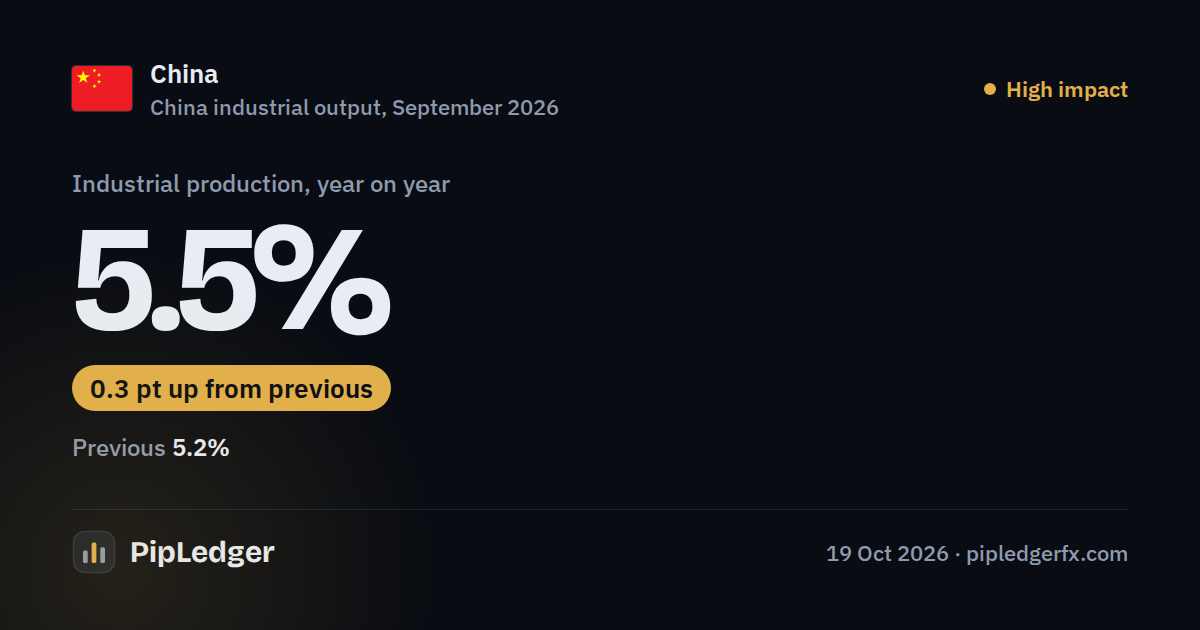
China's industrial output growth accelerated to 5.5% year on year in September 2026, supported by a 6.0% expansion in the manufacturing sector.
By M. A. Horaira. Published . 2 minute read.
0.3 pt up from previous
In 30 seconds
- September industrial output rose 5.5% year on year, up 0.3 percentage points from August.
- High-tech manufacturing showed strong momentum, expanding 15.3% year on year in September.
- Output rose 0.61% month on month, taking January-to-September cumulative growth to 5.3%.
What the numbers showed
China's value-added industrial output for enterprises above designated size rose 5.5% year on year in real terms in September 2026. This was an acceleration of 0.3 percentage points compared to the 5.2% recorded in the previous month. No market forecast was available for the release.
Across key sectors, manufacturing output grew by 6.0% year on year, led by a 15.3% expansion in high-tech manufacturing. Mining output expanded by 1.3% over the same period. On a month-on-month basis, value-added industrial output increased by 0.61% in September, bringing cumulative year-on-year growth from January to September to 5.3%.
How markets reacted
| Market | Move | Measured |
|---|---|---|
| Gold (XAUUSD) | +0.34% | $4,167.90 at 6:53 a.m. IST to $4,181.90 at 8:54 a.m. IST |
Gold (XAUUSD) moved +0.34%, rising from $4,167.90 at 6:53 a.m. IST to $4,181.90 at 8:54 a.m. IST following the release.
Why it matters
Industrial production data from China offers an important snapshot of economic health in the world's second-largest economy and heavily influences sentiment across global financial markets. An acceleration in factory activity tends to reflect firmer demand for raw materials and industrial inputs, which can bolster commodity prices and commodity-linked currencies such as AUDUSD.
For foreign exchange markets, shifts in Chinese output can also alter expectations around domestic monetary settings and regional trade momentum. Stronger domestic industrial activity tends to support the Chinese yuan against the US dollar, which can prompt adjustments in currency pairs like USDCNH.
What it means for India
For traders in India, Chinese industrial momentum often influences broader emerging market risk appetite and foreign portfolio investor flows. Shifts in regional economic momentum can drive capital reallocations that affect the Indian rupee.
Commodity market participants should note that domestic MCX gold contracts are quoted in rupees and track movements in both international spot prices (XAUUSD) and the USDINR exchange rate. Broader swings in global risk sentiment and industrial demand stemming from Chinese economic data can therefore influence local bullion and foreign exchange pricing.
What to watch next
Traders will look ahead to Canada CPI for September, scheduled for release on Mon 19 Oct 2026 at 6:00 p.m. IST. Further insight into China's broader economic conditions will follow with the release of October CPI and PPI figures on Mon 9 Nov 2026 at 7:00 a.m. IST.
Quick answers
What does China's industrial output measure?
It measures the real volume of output produced by large industrial enterprises above designated size across sectors including manufacturing and mining.
Why does China industrial output affect AUDUSD?
Australia is a key commodity supplier to China. Higher Chinese industrial production tends to signal stronger resource demand, which can support the Australian dollar.
How does this release impact gold traders in India?
Chinese economic reports can influence global risk sentiment and spot gold prices (XAUUSD). Because domestic MCX gold prices track both international spot prices and the USDINR rate, moves in either can affect local bullion contracts.
Sources
This article explains a scheduled economic release for education. It is not investment advice or a recommendation to buy or sell anything. Prices move fast around news; check live quotes before you trade.